

Sculptural cocktail ring with a free flowing green tourmaline attributed to Haroldo Burle Marx.
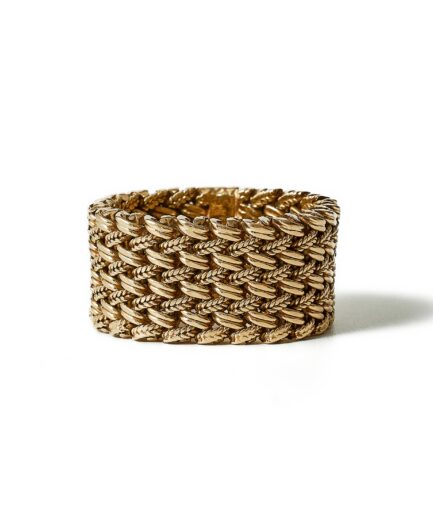
Shank decorated with basket weave finish indicate that it is a fairly early piece. Burle Marx stopped using this finish in 1979. Burle Marx jewels were completely hand made. There was no pre-casting. Every piece is unique. The ring shows some minor wear, small dents to the shank and some minor nicks to the stone that are felt when running your fingers across the stone.
Width ca 5 – 25 mm, size us 6.5, M½, 17, 53.
Total weight 15.6 grams. Halmarked 750. Unsigned.
Haroldo Burle Marx and the “Forma Livre” Aesthetic
Born to a wealthy and well connected Jewish-German family exiled at the end of the 19th century (Burle Marx’s grandfather was a cousin of Karl Marx), all three brothers were creative: Walter became a composer and conductor for the Philharmonic Orchestra of Rio de Janeiro; Roberto, a well known landscaper, urban planner, painter and botanist (responsible for designing the Copacabana waterfront); Haroldo boldly embraced the art of jewelry.
Haroldo Burle Marx (1911–1991) is regarded as one of Brazil’s most important mid-century jewelry designers, known for creating a modern, distinctly Brazilian voice in fine jewelry. He wrote and spoke six languages fluently, and earned several university degrees, including in law. He eventually also became a gemologist, studying gems for four years in Idar-Oberstein, Germany. By 1945, he was designing jewelry.
Inspired by his brother, the celebrated landscape architect Roberto Burle Marx (that he on a personal level had a long falling out with), Haroldo drew inspiration from the same organic lines, fluid movement and sculptural sensibility that defined Roberto’s garden designs.
His most influential contribution was the development of the “forma livre” or freeform gemstone style. Rather than using traditional European cuts, Haroldo pioneered hand-carving Brazilian gemstones into natural, asymmetrical shapes. Each stone was treated as a small sculpture and chosen for its innate qualities. Tourmalines, aquamarines, topazes and quartz became central to this new artistic language, reflecting the geological richness of Brazil.
The dialogue between the Burle Marx brothers resulted in jewelry that feels architectural yet deeply connected to nature. Haroldo’s goldwork frames the freeform stones with soft, flowing lines that mirror the biomorphic curves found in Roberto’s landscapes.
Haroldo Burle Marx’s work established an aesthetic that reshaped modern jewelry. He elevated Brazilian gemstones internationally, introduced a design language rooted in the country’s natural forms and helped define what is now one of the most influential styles in contemporary jewelry. His “forma livre” pieces remain celebrated for their originality, craftsmanship and unmistakably Brazilian character.
His jewels are found in the most important international collections, famous clients included: Her Majesty the Queen Elizabeth II of England, Iranian Empress Farah Pahlavi, Carrol Petrie, Valentino, Cicely Tyson, Madame Ferragamo, Placido Domingo, Natalie Wood, Queen Margrethe of Denmark, and the Empress of Japan.