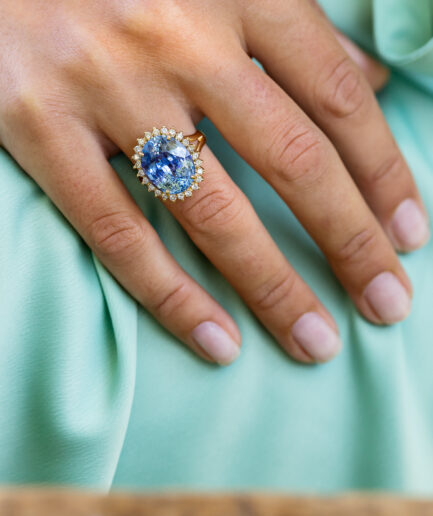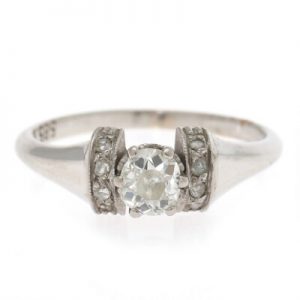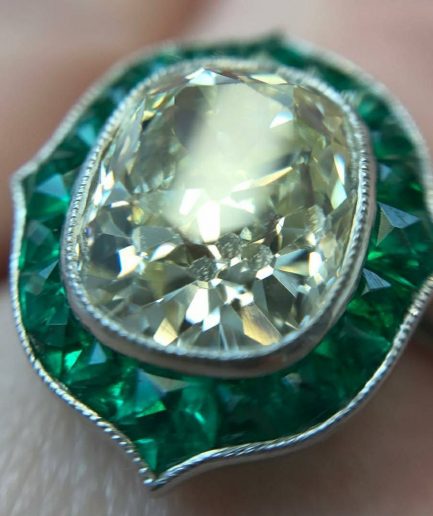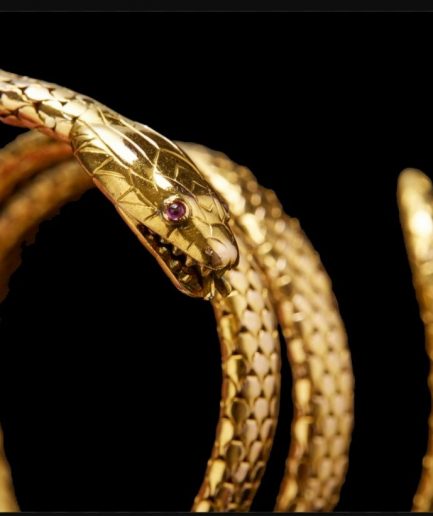
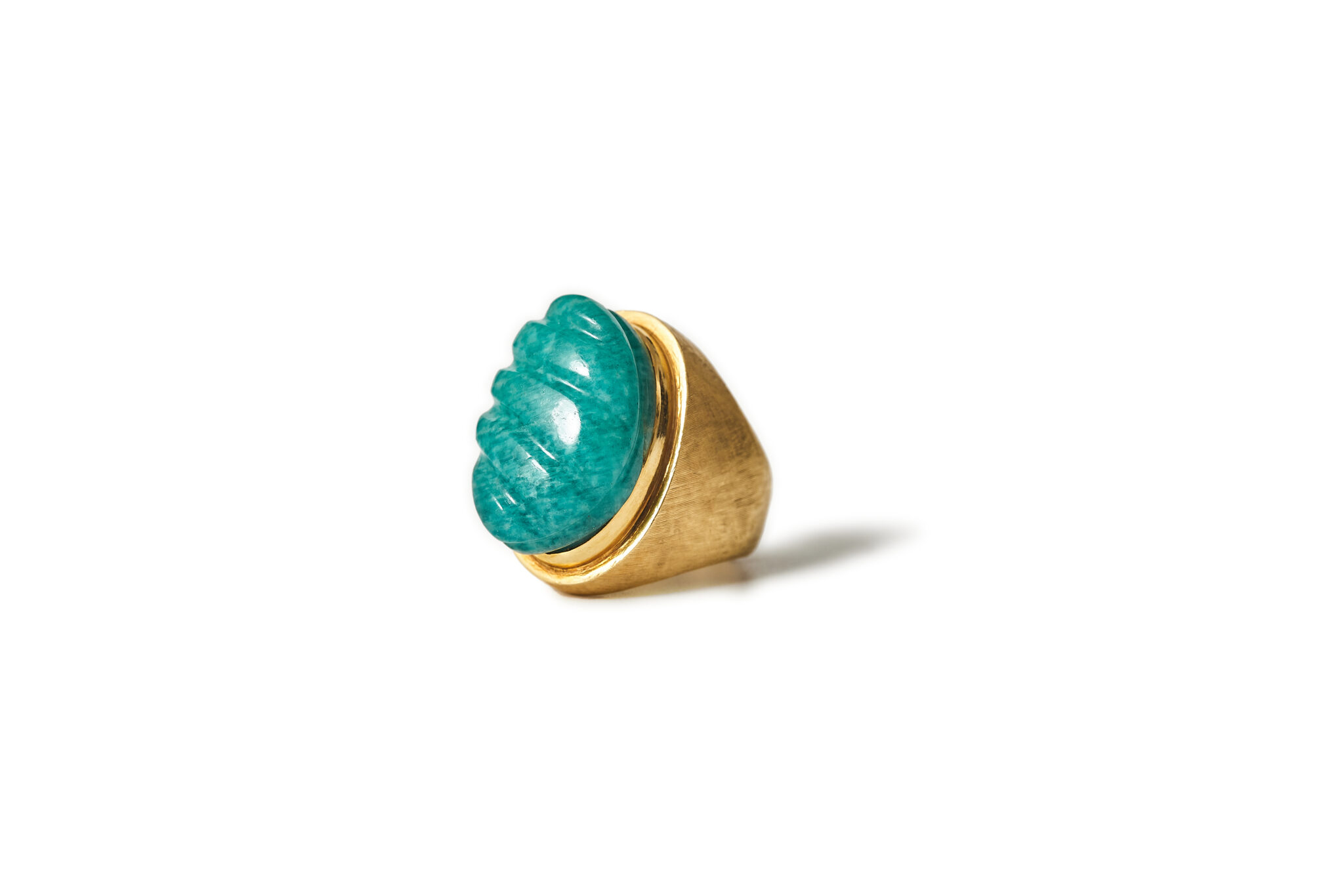
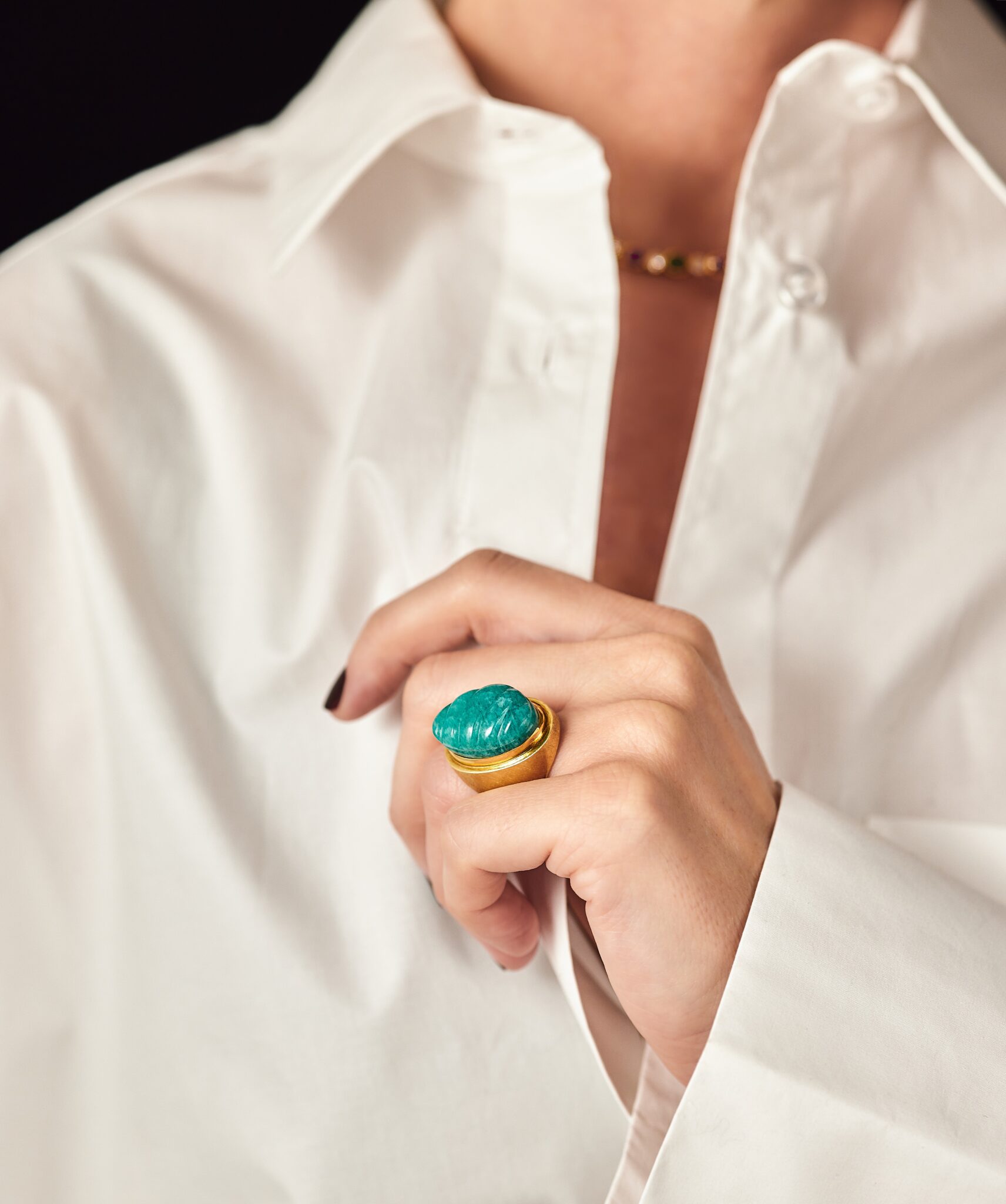
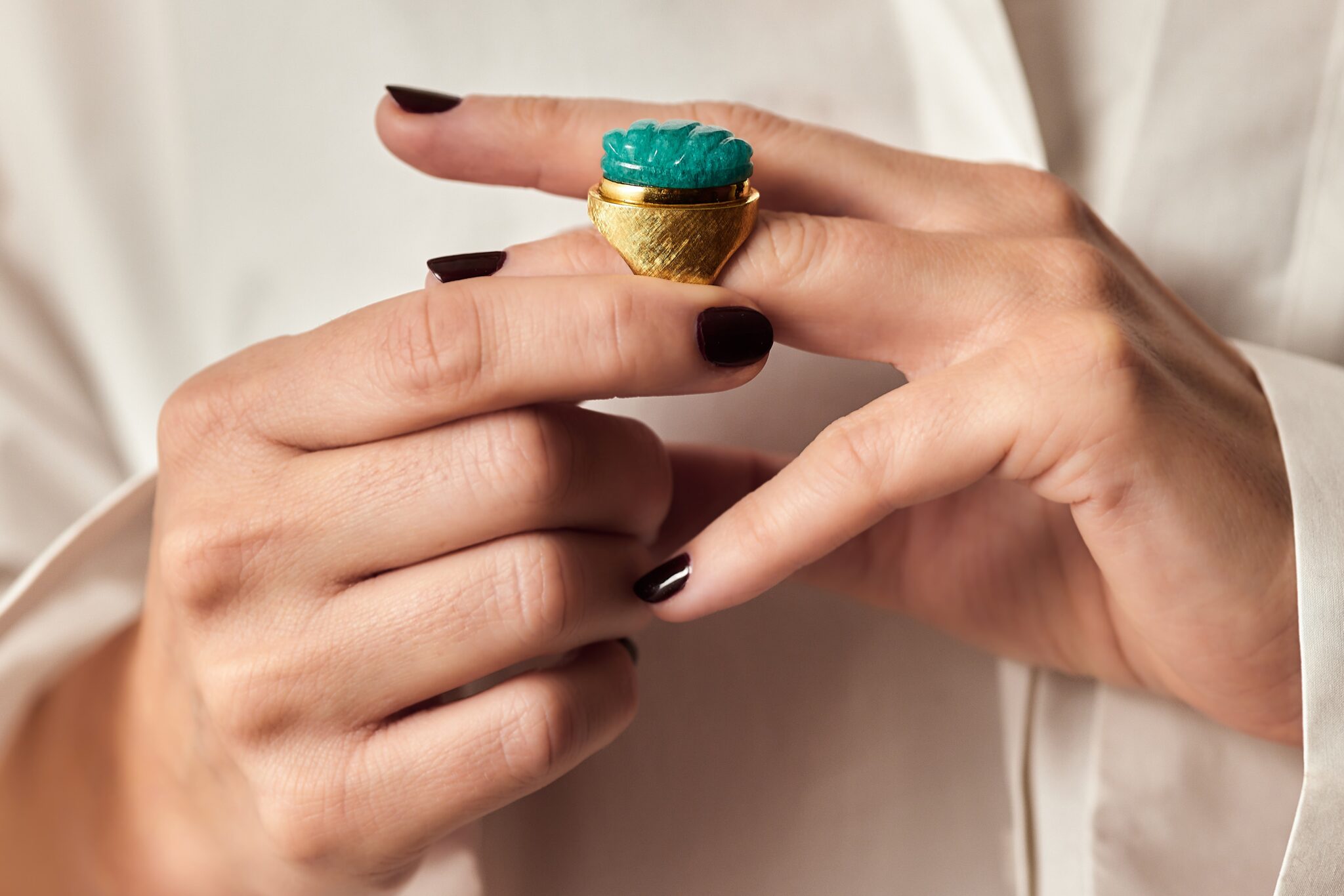
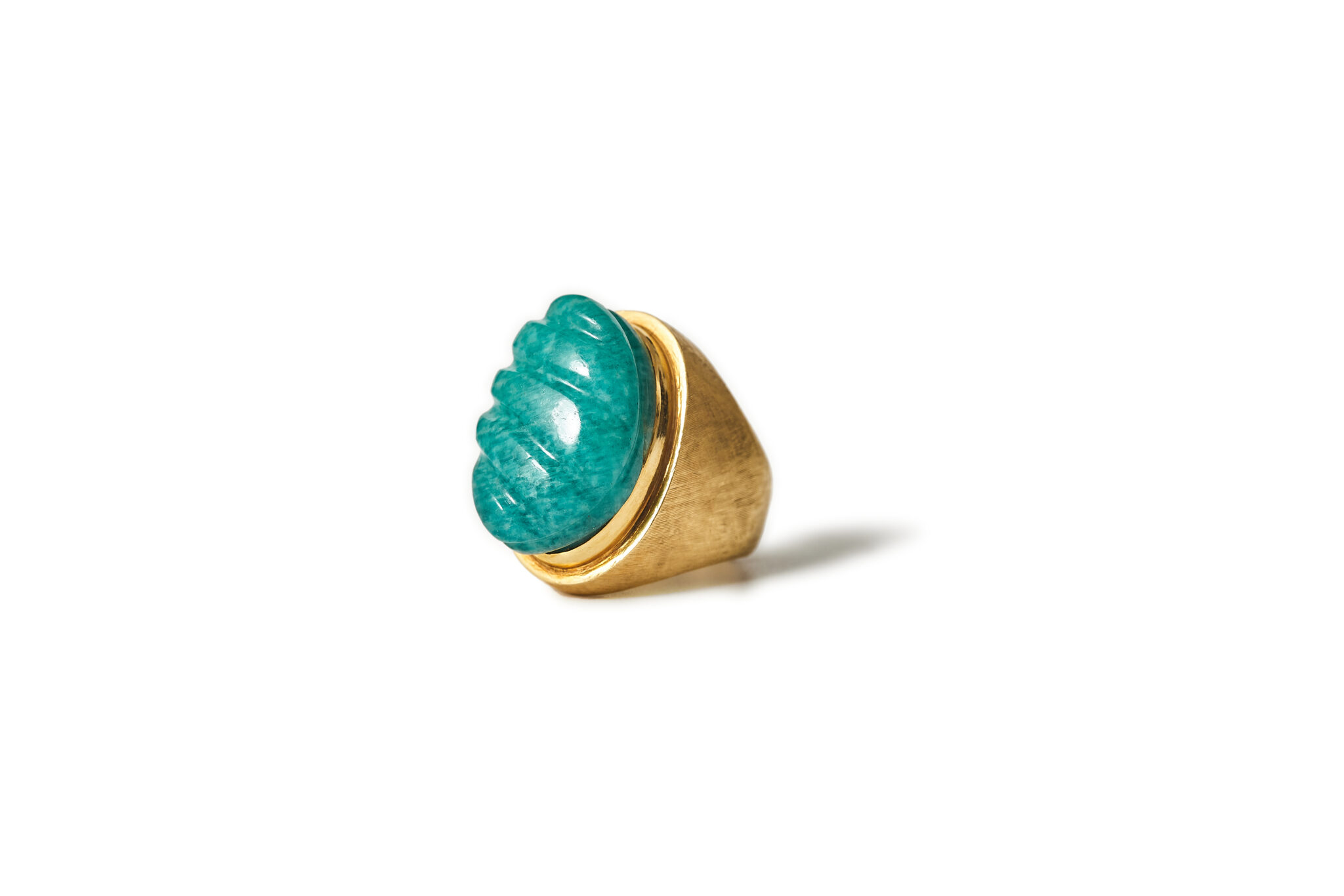
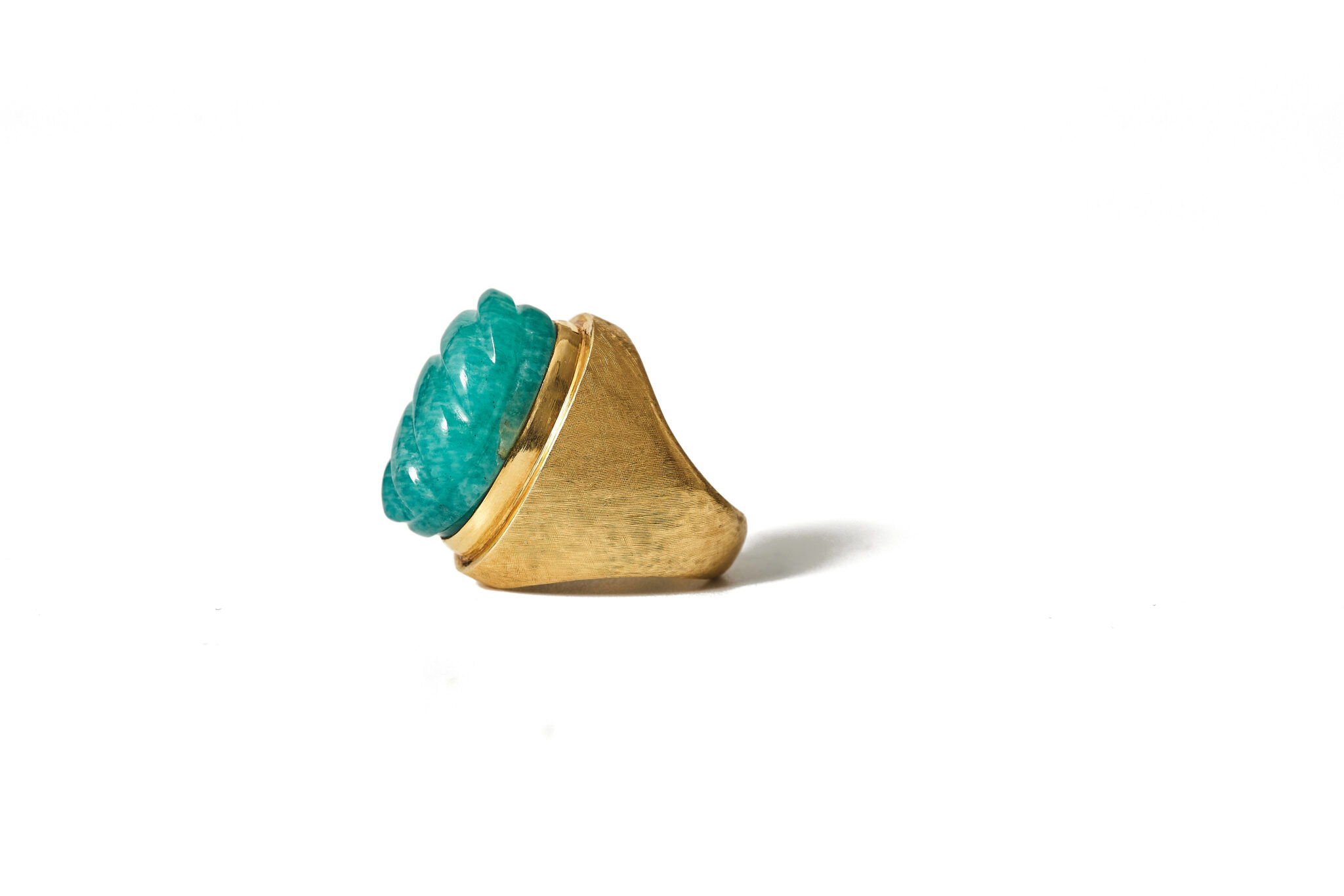
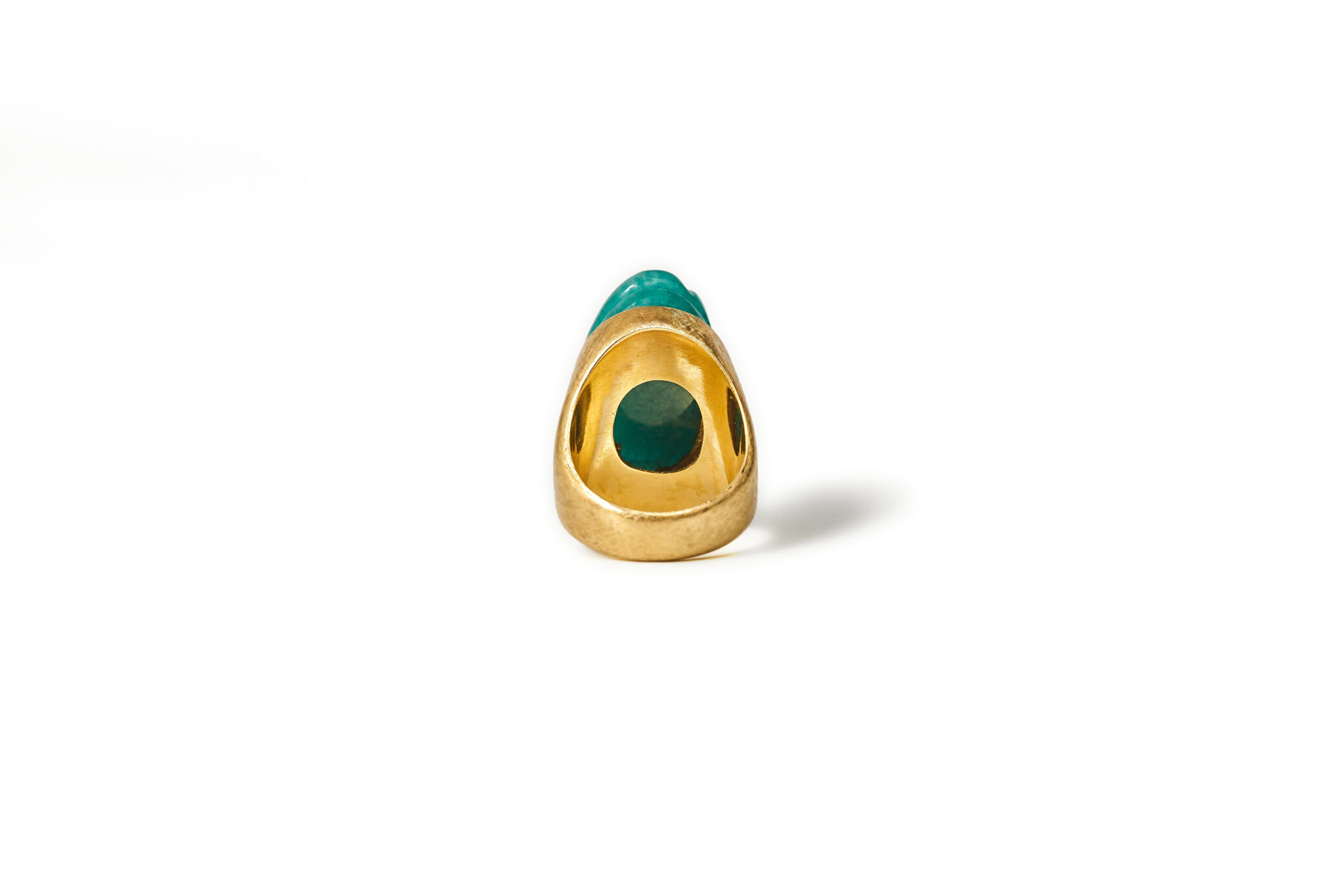
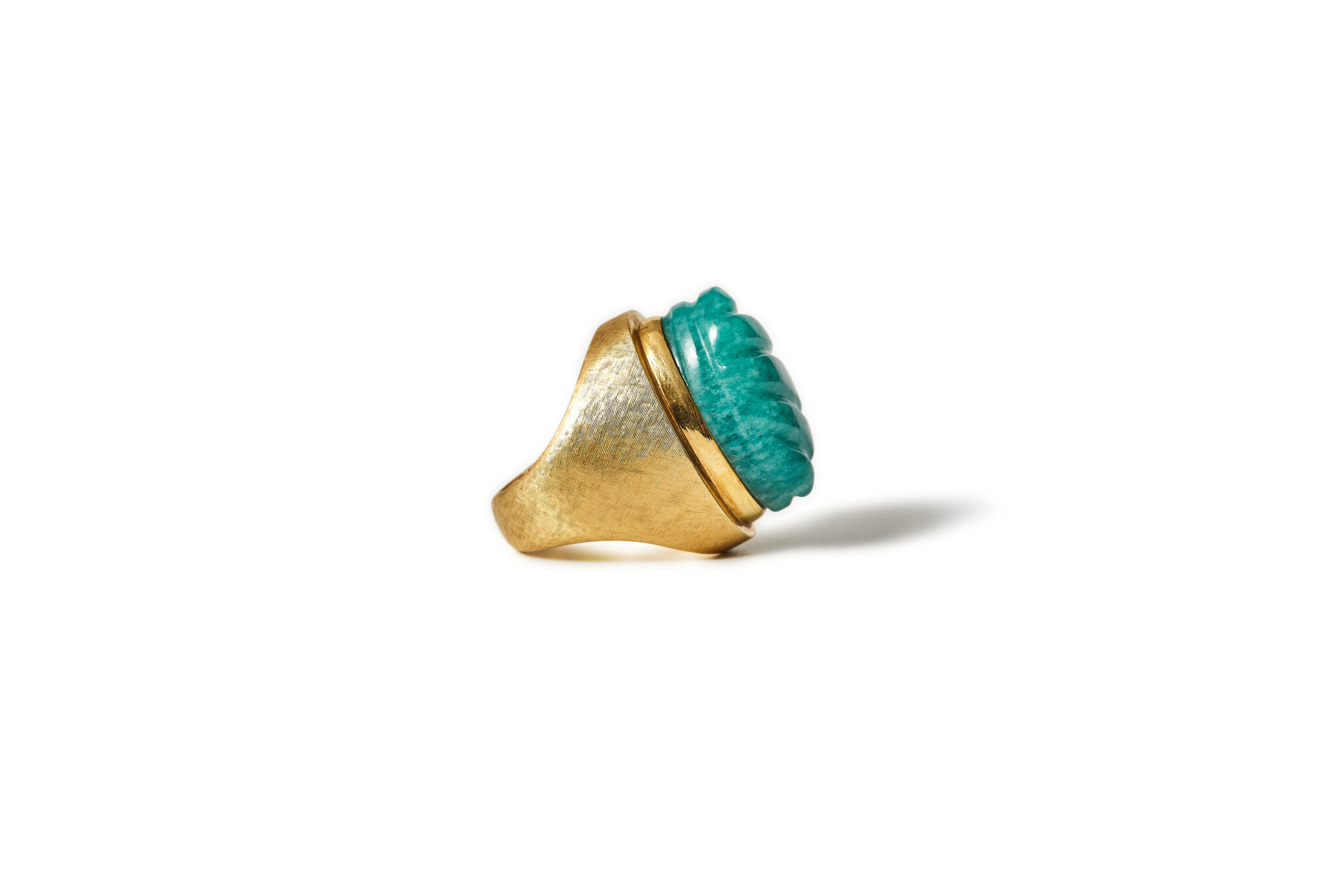

Sculptural cocktail ring with a free flowing blue green amazonit attributed to Haroldo Burle Marx.
Shank decorated with basket weave finish that indicate that it is a fairly early piece. Burle Marx stopped using this finish in 1979. Burle Marx jewels were completely hand made. There was no pre-casting. Every piece is unique. The ring is in good condition, with a surface reaching inclusion in one side low by just by the setting.
Stone measures approx 14.5mm x 21.2mm.
Ring size us 5, 49, J½, 15.75, total weight 13.1 grams.
Halmarked 750. Unsigned.
Amazonite is a distinctive blue-green feldspar prized for its soft, watery color and subtle internal shimmer. Major deposits have been mined for centuries in regions such as Egypt, India, Russia, and later the Americas.
Amazonite has a long history of use in jewelry and ornament. It was highly valued in ancient Egypt, where it was carved into beads, amulets, and inlays, often associated with protection, harmony, and renewal. The stone appears in funerary objects and sacred adornments, underscoring its symbolic importance.
Today, amazonite is admired for its calming color, natural elegance, and historical resonance, making it a favored gemstone in both antique and modern jewelry for its beauty and sense of timeless serenity.
Haroldo Burle Marx and the Forma Livre Aesthetic
Haroldo Burle Marx (1911–1991) was one of Brazil’s most influential mid-century jewelry designers, instrumental in shaping a modern and distinctly Brazilian language in fine jewelry. Born into a wealthy, intellectually prominent Jewish-German family exiled from Europe in the late 19th century, creativity ran deeply in the Burle Marx lineage. His brothers followed artistic paths of their own: Walter became a composer and conductor with the Rio de Janeiro Philharmonic, while Roberto rose to international renown as a landscape architect, urban planner, painter, and botanist, famously responsible for the design of Rio’s Copacabana promenade.
Exceptionally erudite, Haroldo spoke and wrote six languages fluently and earned multiple university degrees, including in law, before turning fully to jewelry. His technical foundation was completed with four years of gemological study in Idar-Oberstein, Germany, and by 1945 he was actively designing jewelry.
Although personally estranged for many years, Haroldo drew profound artistic inspiration from Roberto’s work. The flowing lines, organic movement, and sculptural rhythms of Roberto’s landscapes found a parallel expression in Haroldo’s jewels. His most enduring contribution was the development of the forma livre, or freeform, gemstone aesthetic. Rejecting traditional European cuts, he hand-carved Brazilian gemstones into asymmetrical, natural shapes, treating each stone as a unique sculptural form. Tourmalines, aquamarines, topazes, and quartz became central to this expressive vocabulary, celebrating Brazil’s extraordinary geological wealth.
Haroldo’s goldwork frames these stones with soft, fluid contours that balance architectural structure with natural spontaneity. His approach reshaped modern jewelry by elevating Brazilian materials on the international stage and establishing a design language rooted in nature rather than convention.
Today, Haroldo Burle Marx’s jewelry is represented in major international collections and has been worn by an extraordinary clientele, including Queen Elizabeth II of England, Empress Farah Pahlavi of Iran, Queen Margrethe II of Denmark, the Empress of Japan, and figures from the worlds of art, fashion, and performance. His forma livre creations remain celebrated for their originality, craftsmanship, and unmistakably Brazilian identity.