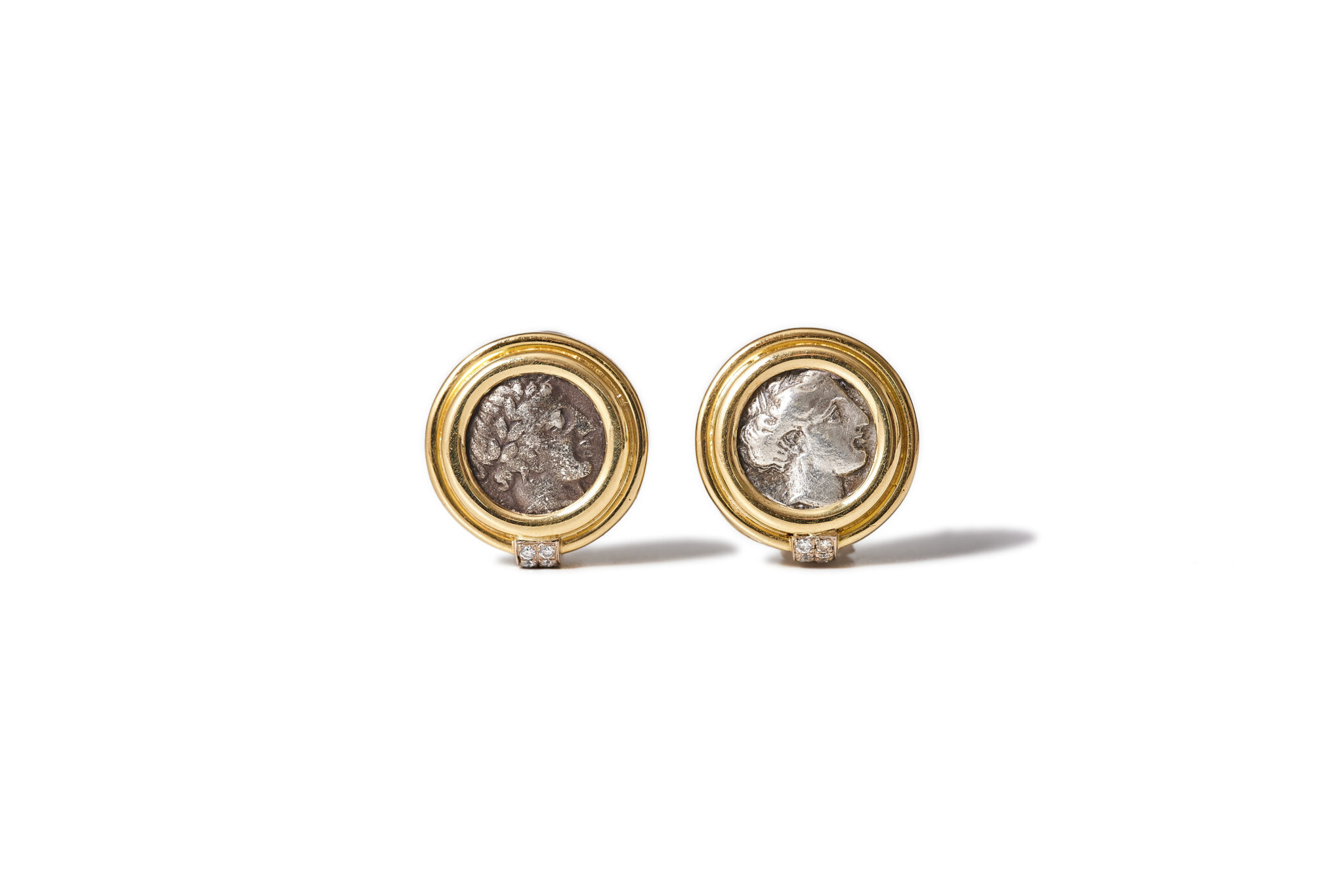
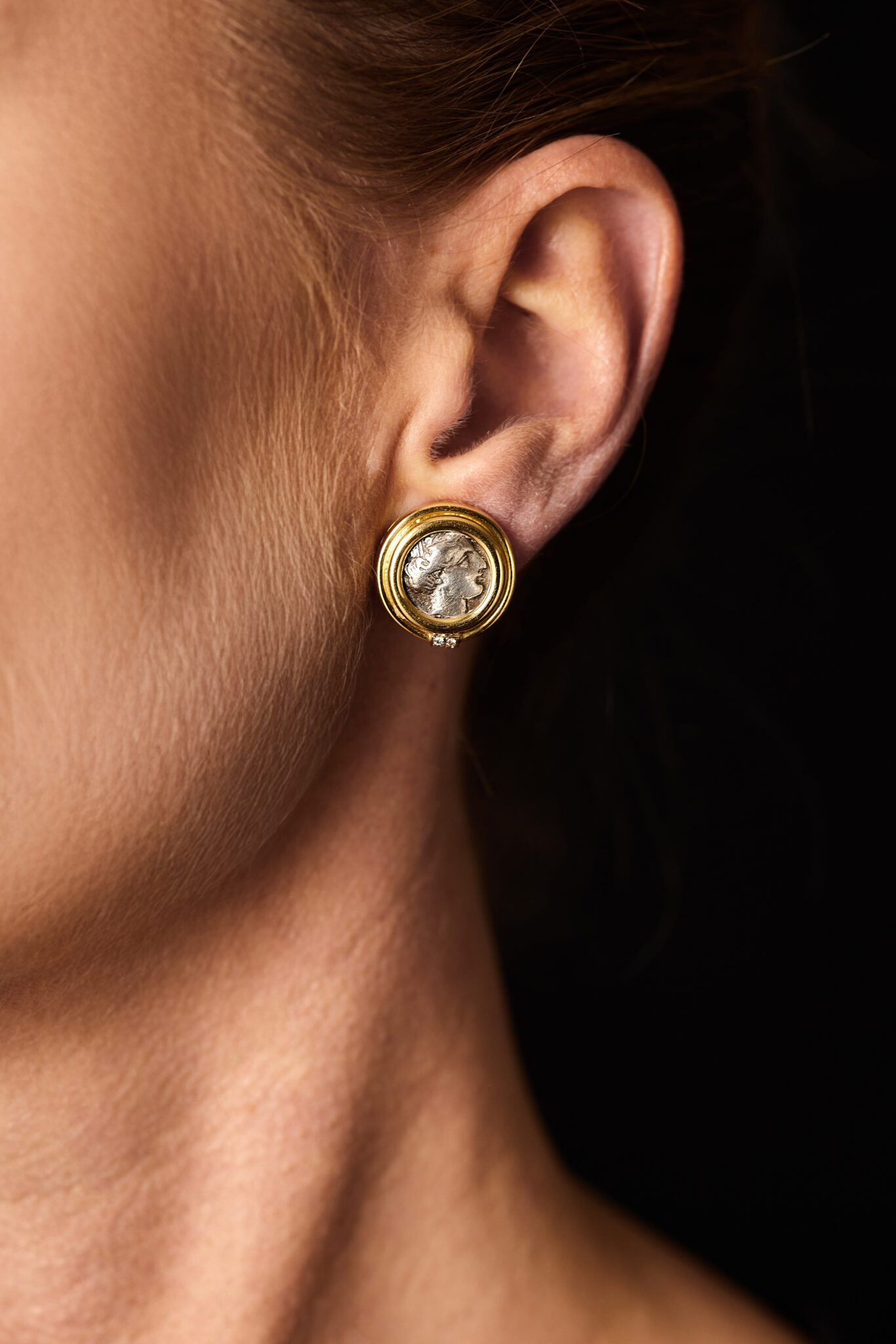
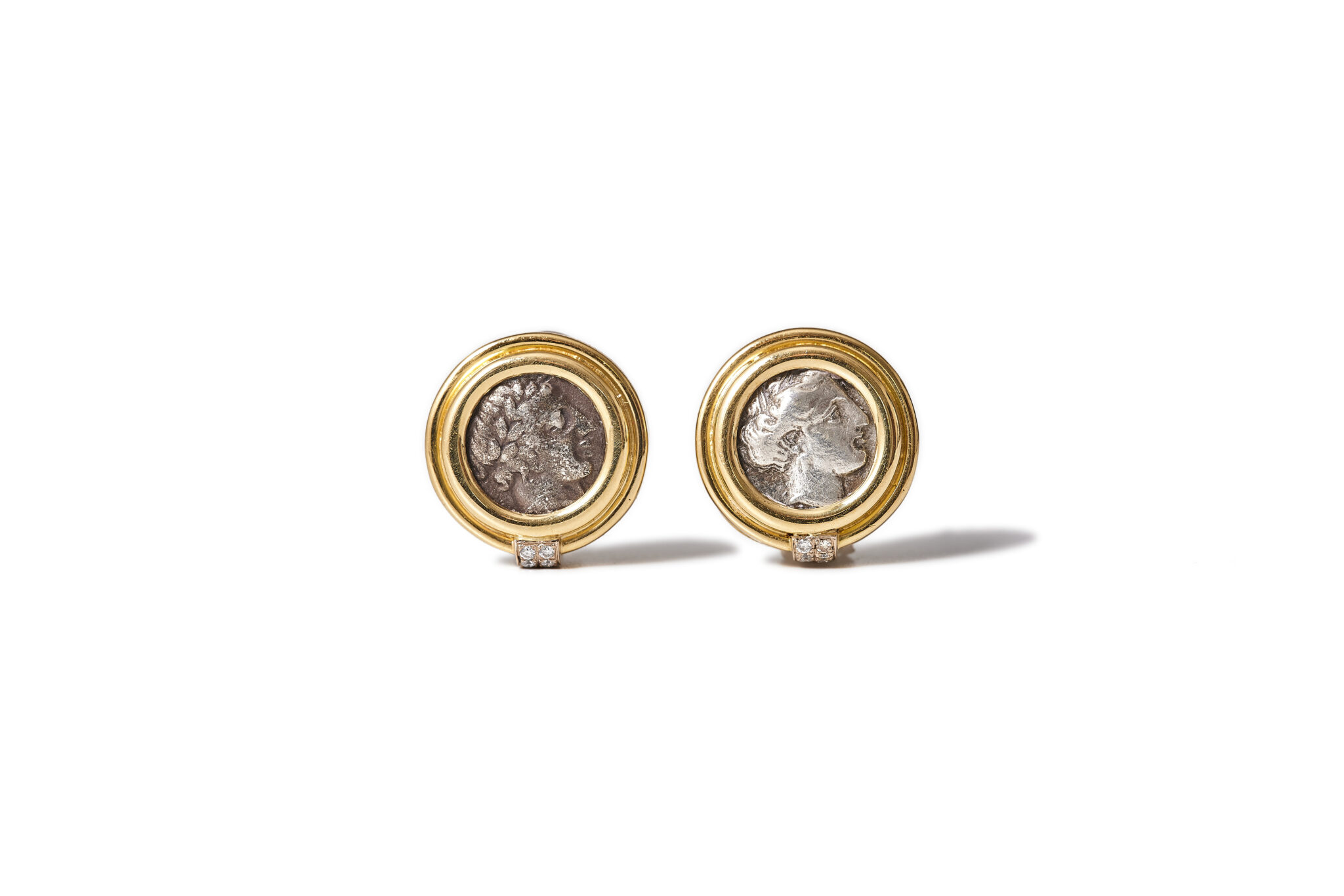
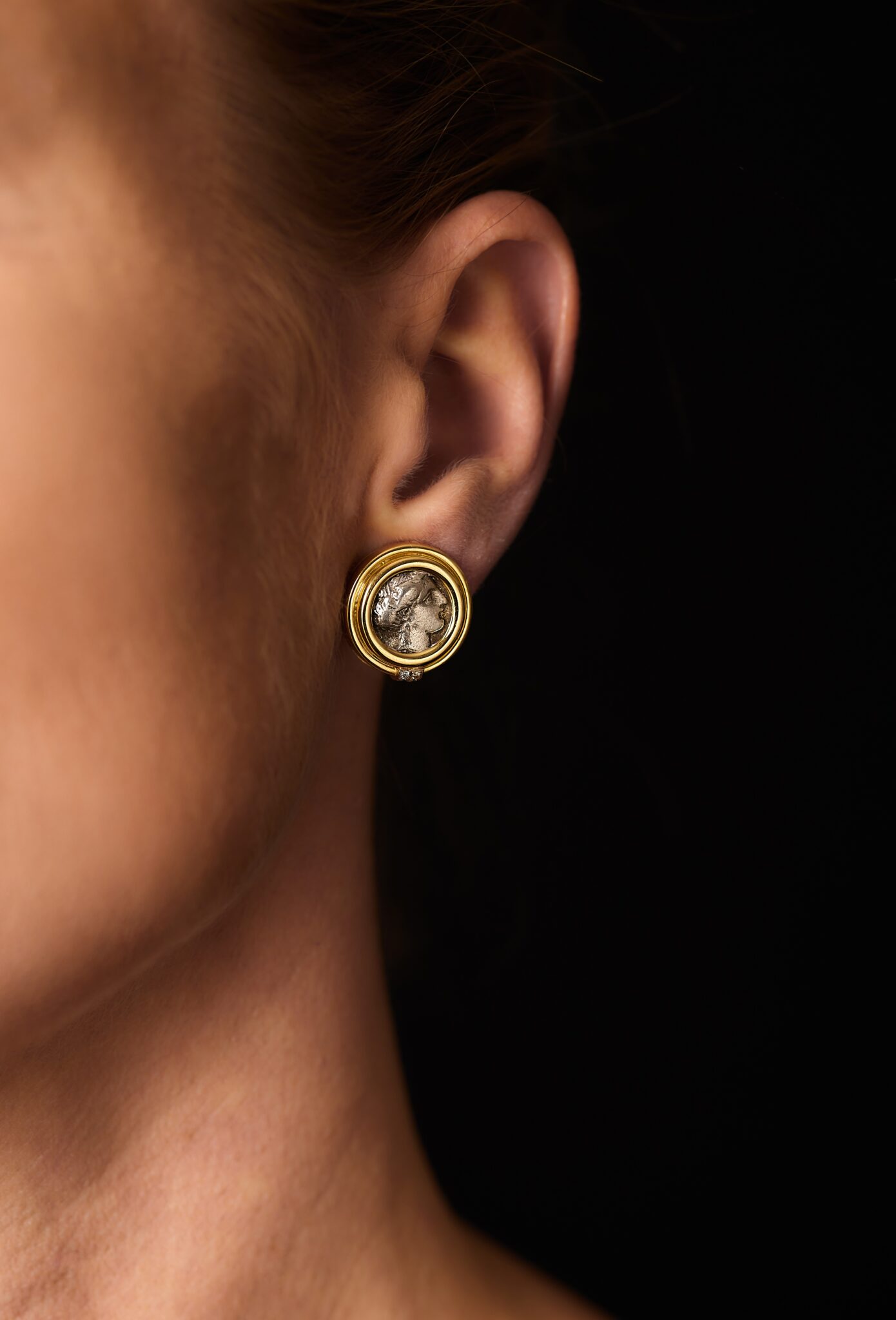
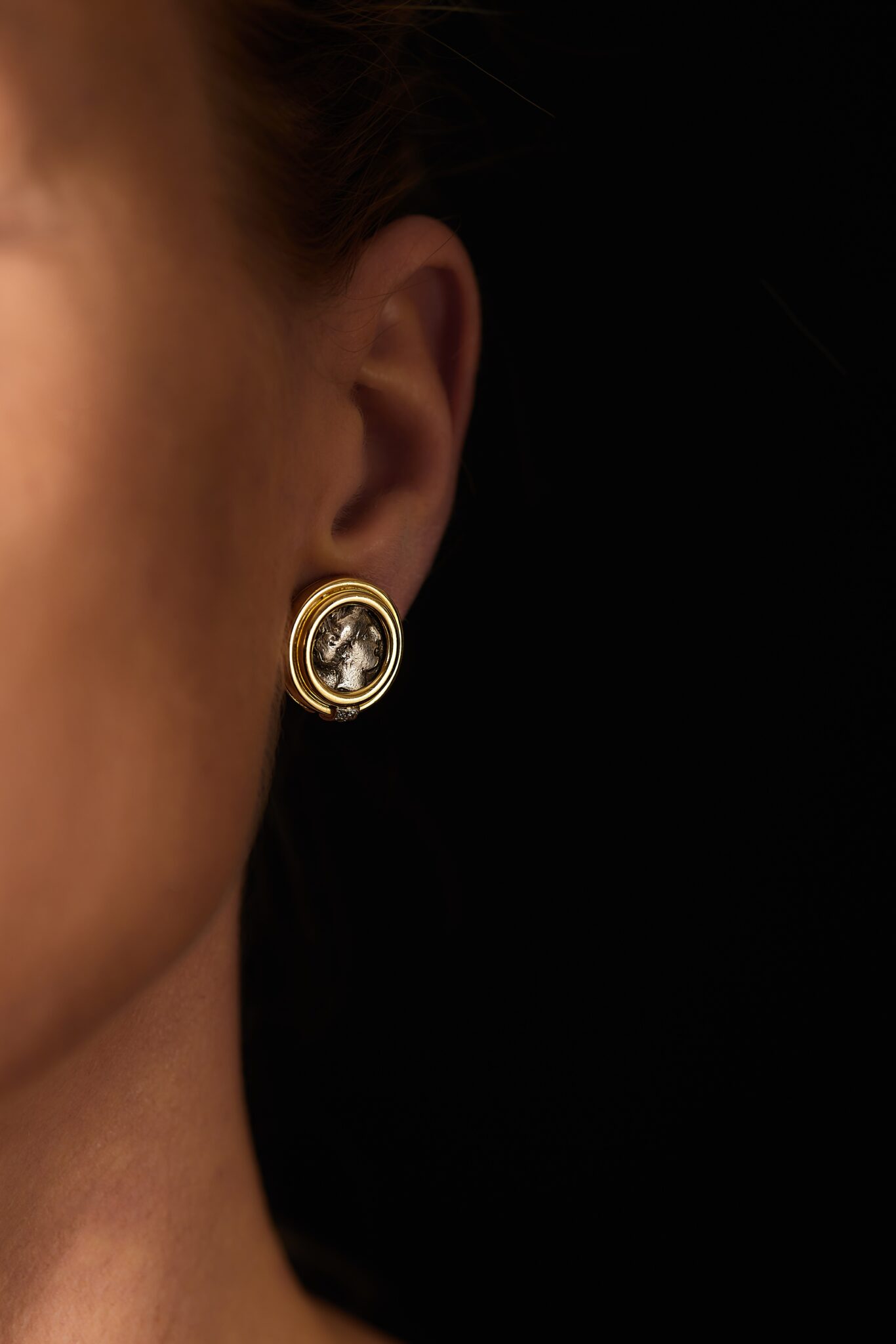
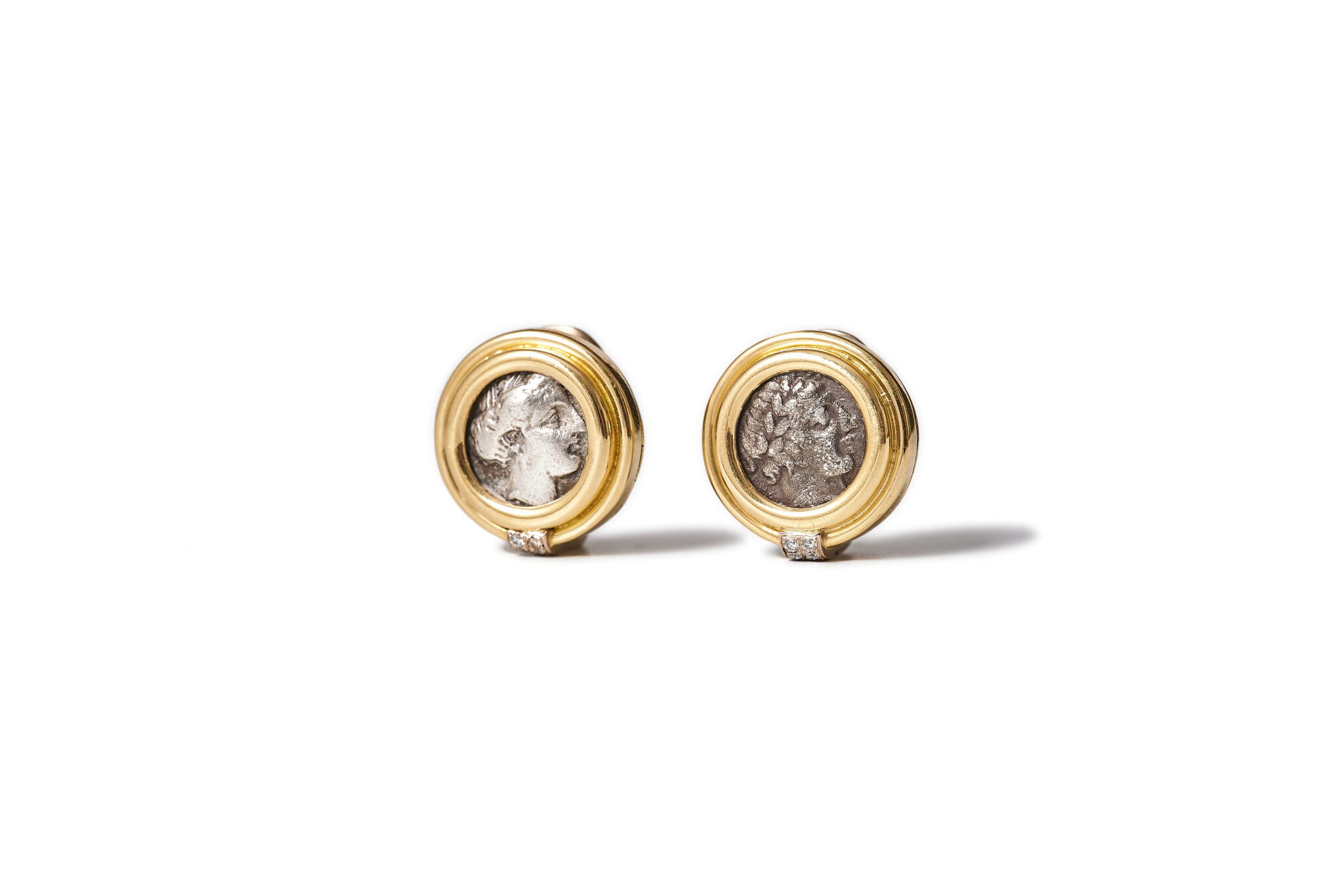
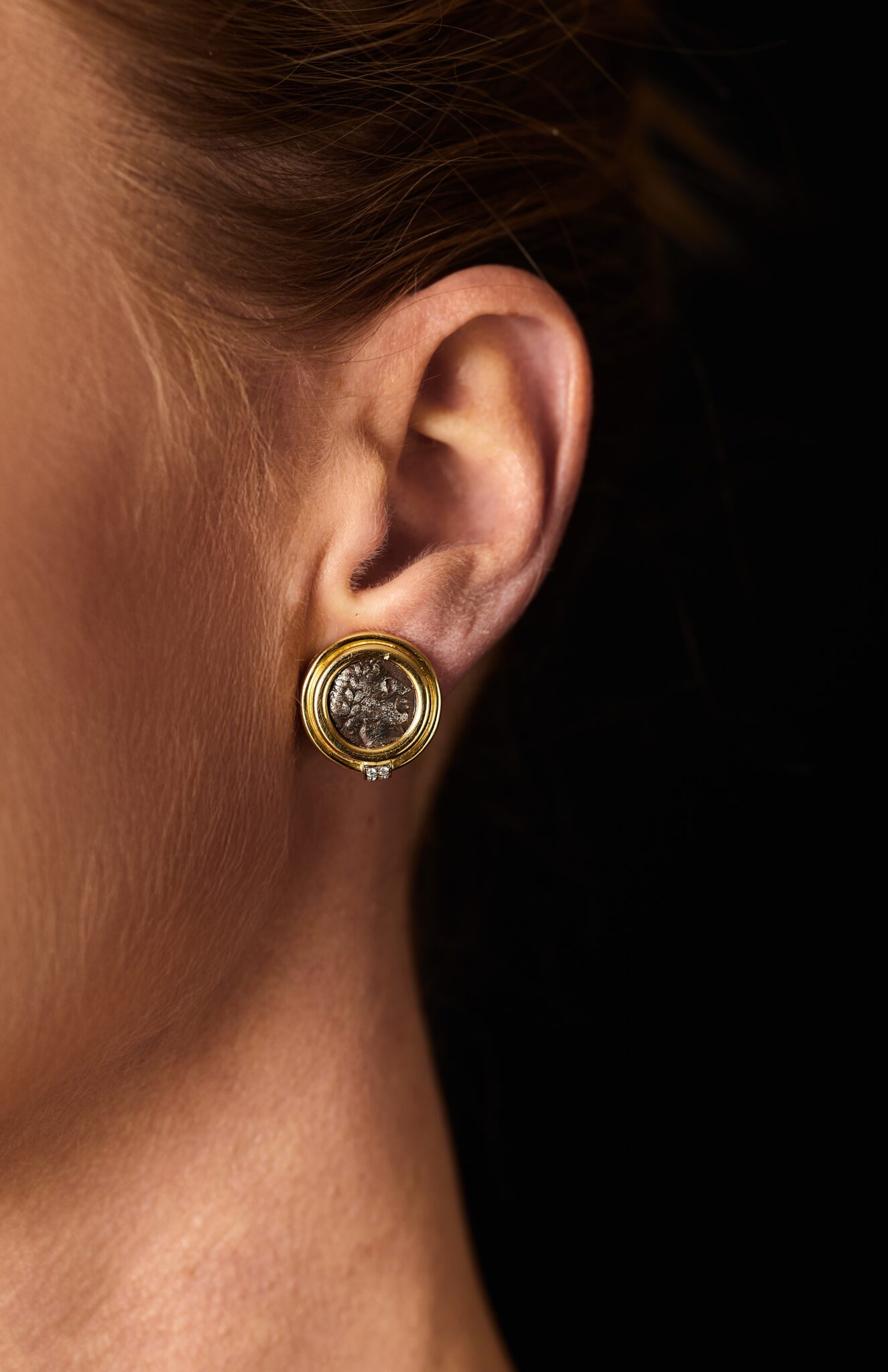
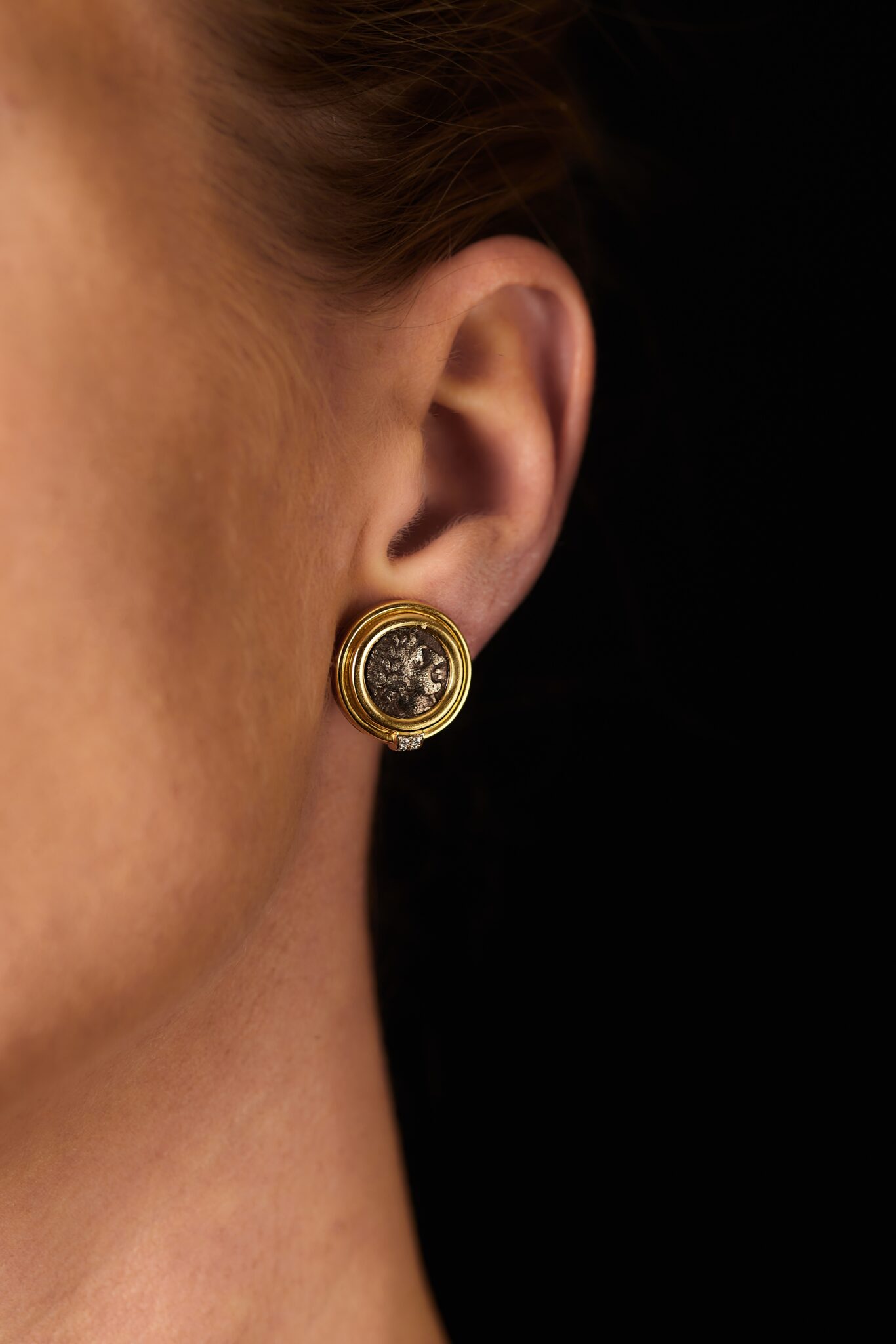
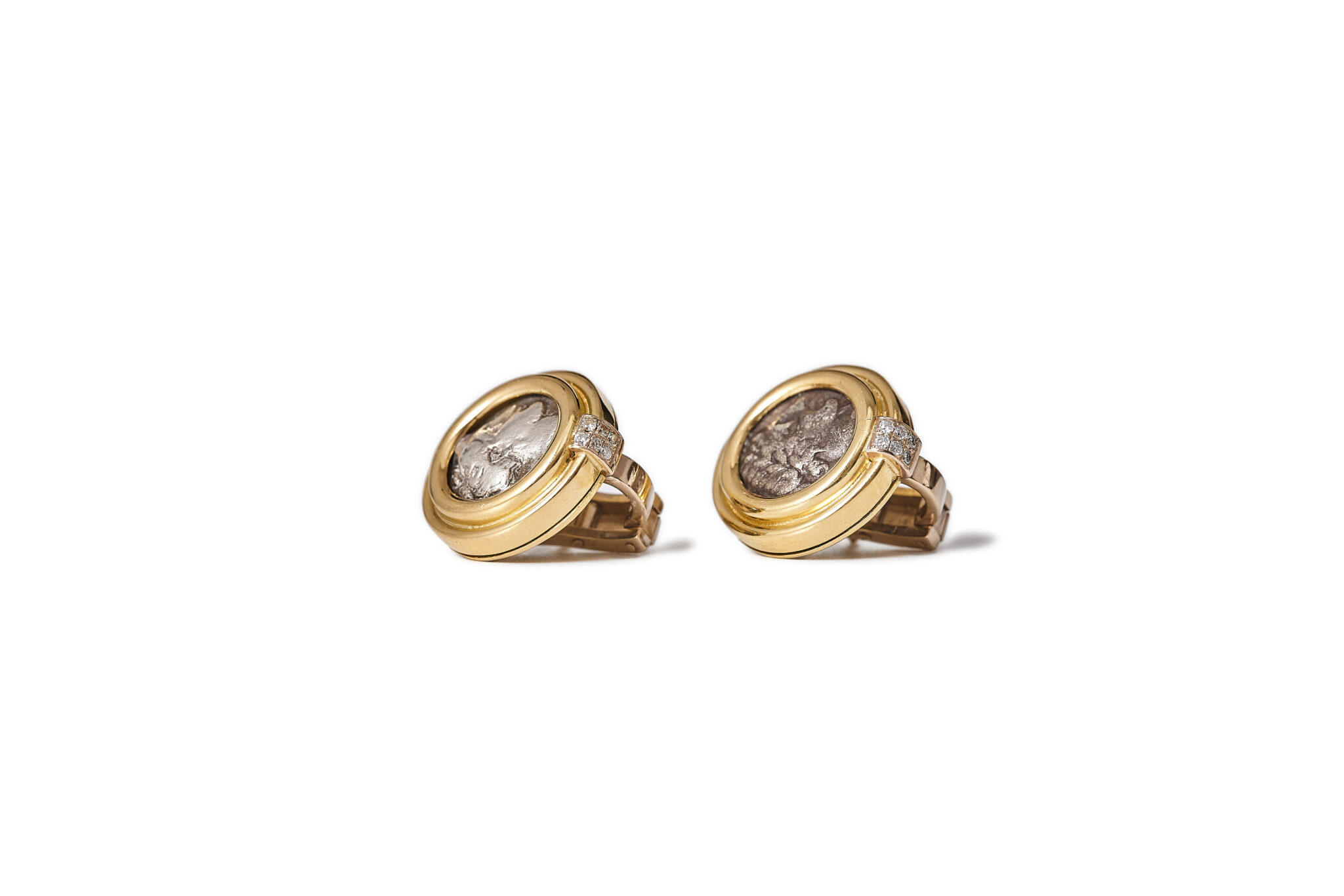
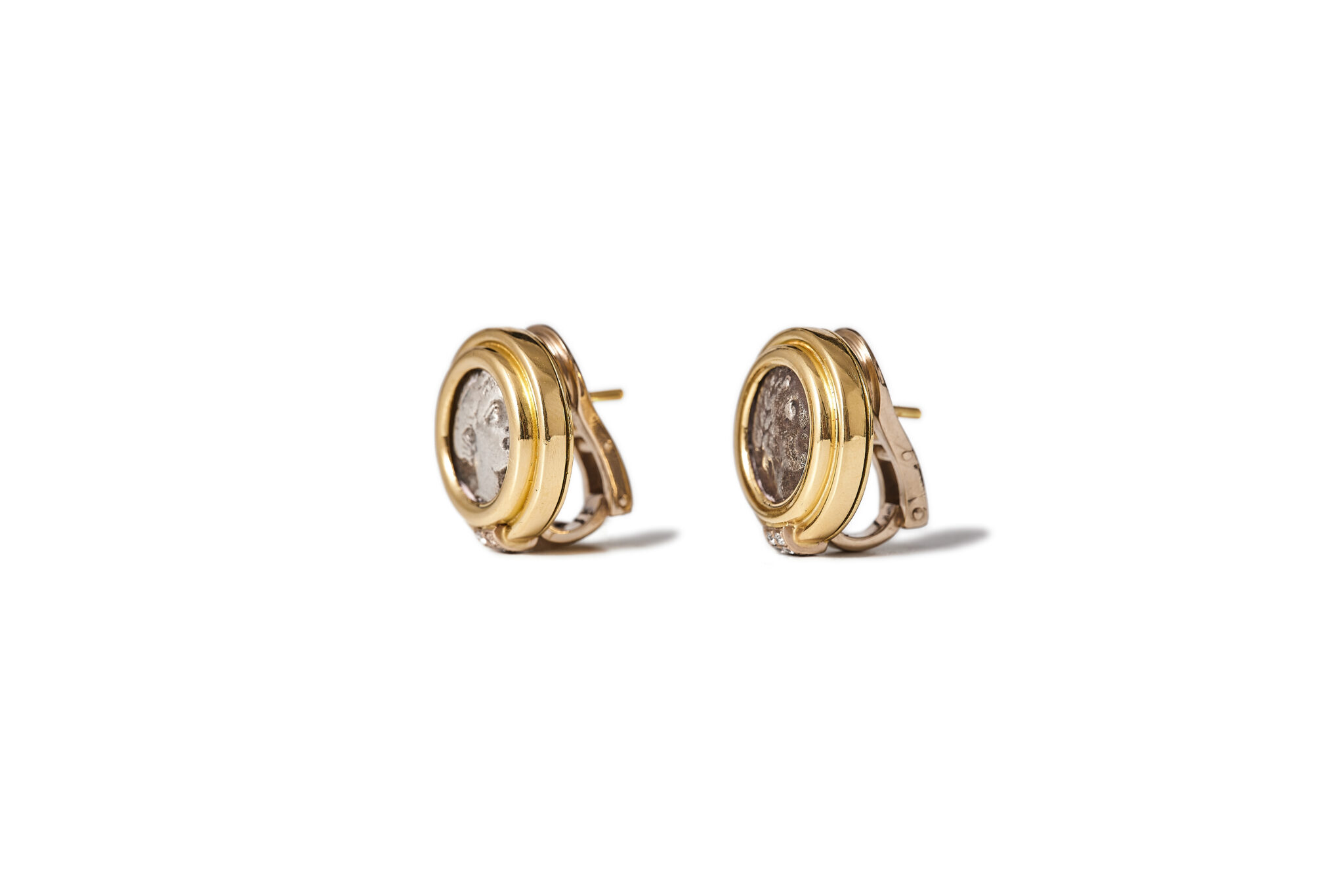
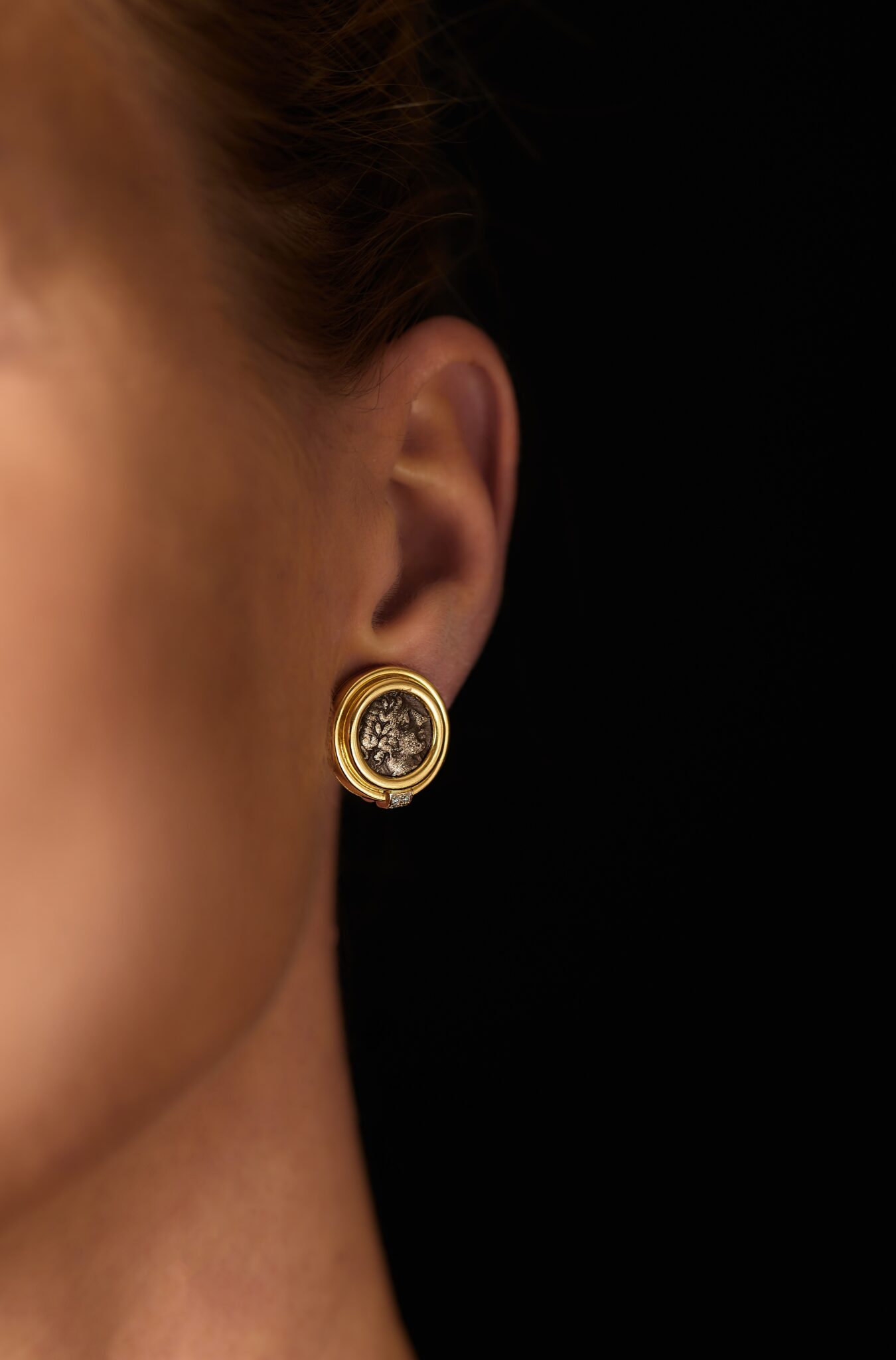
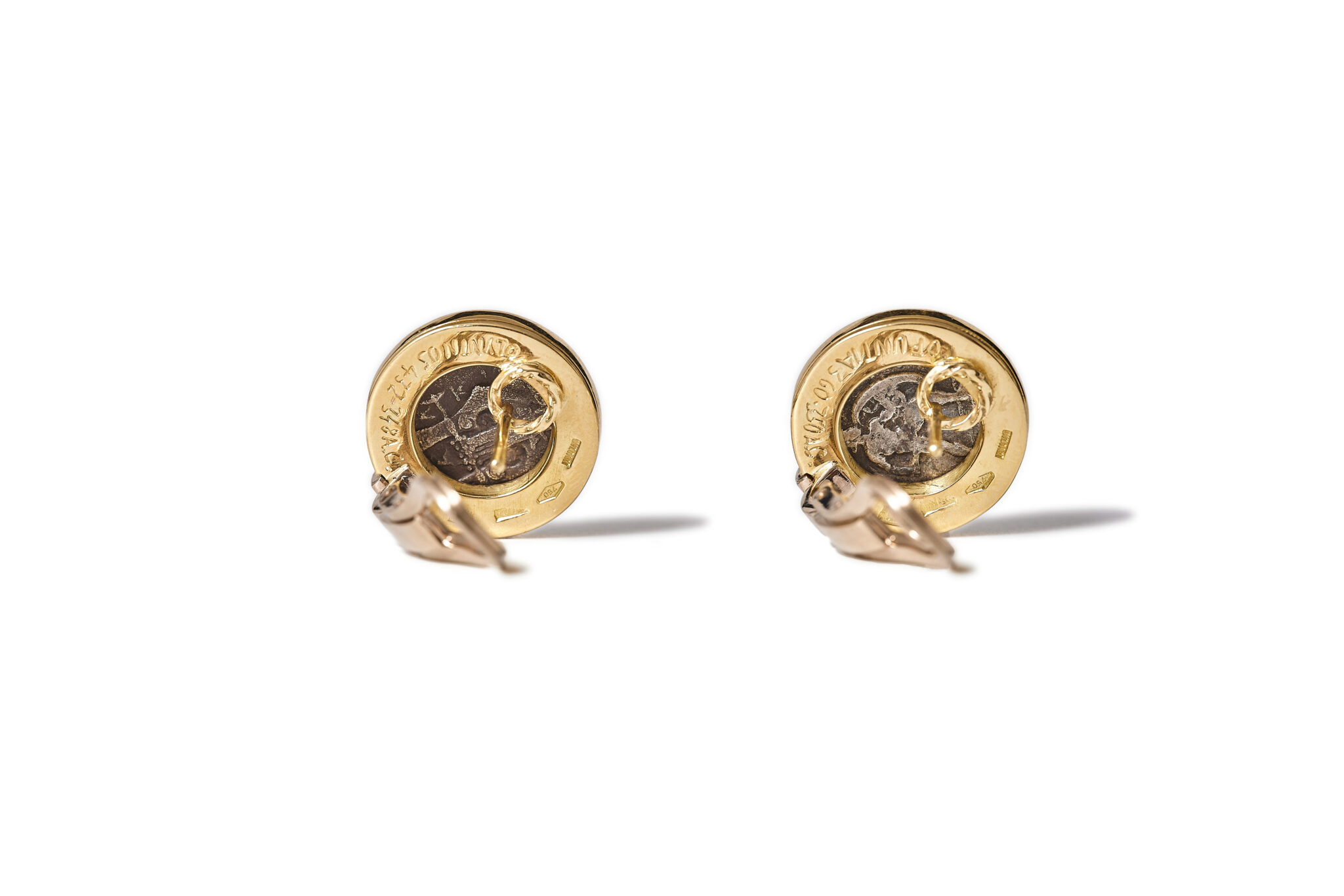
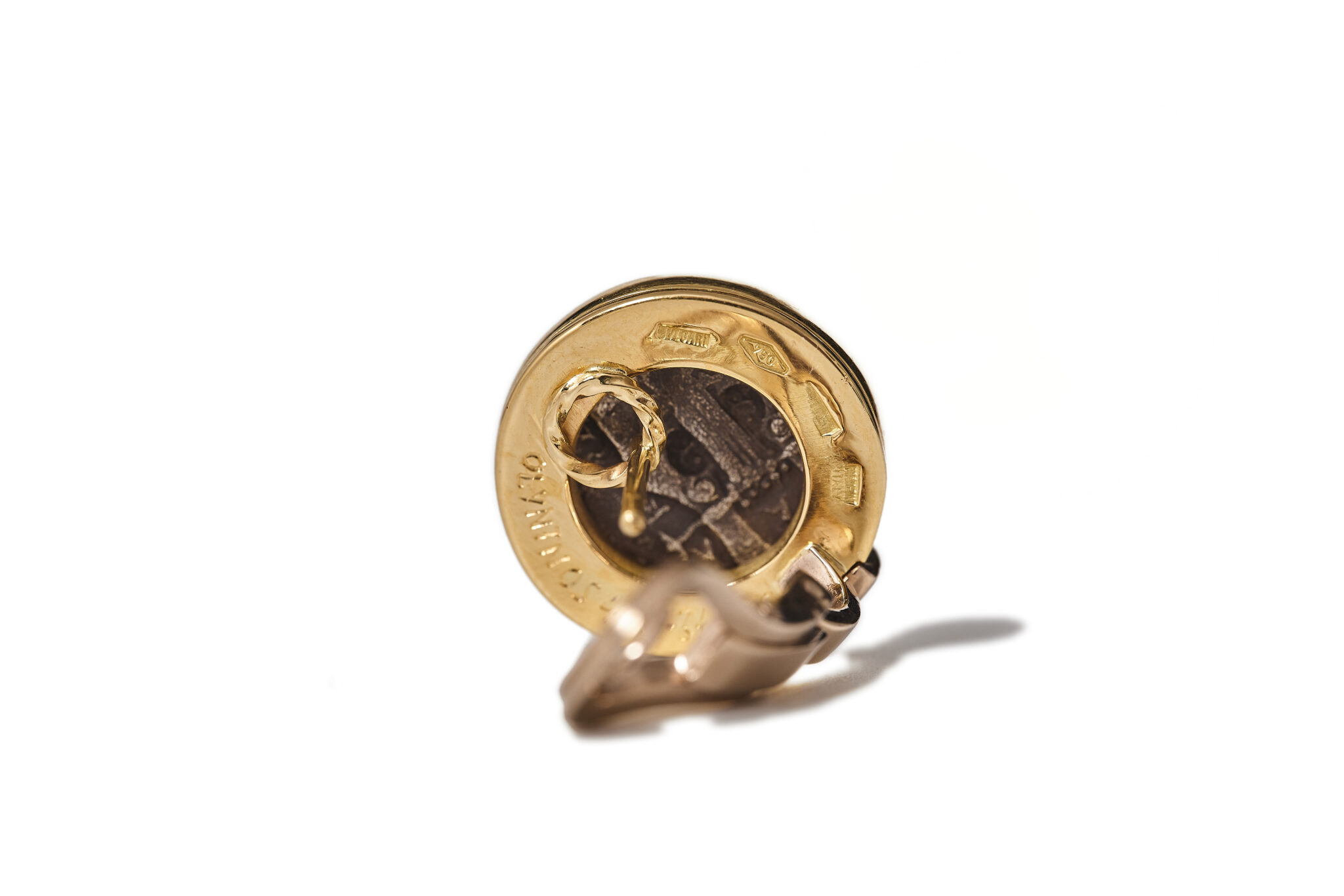
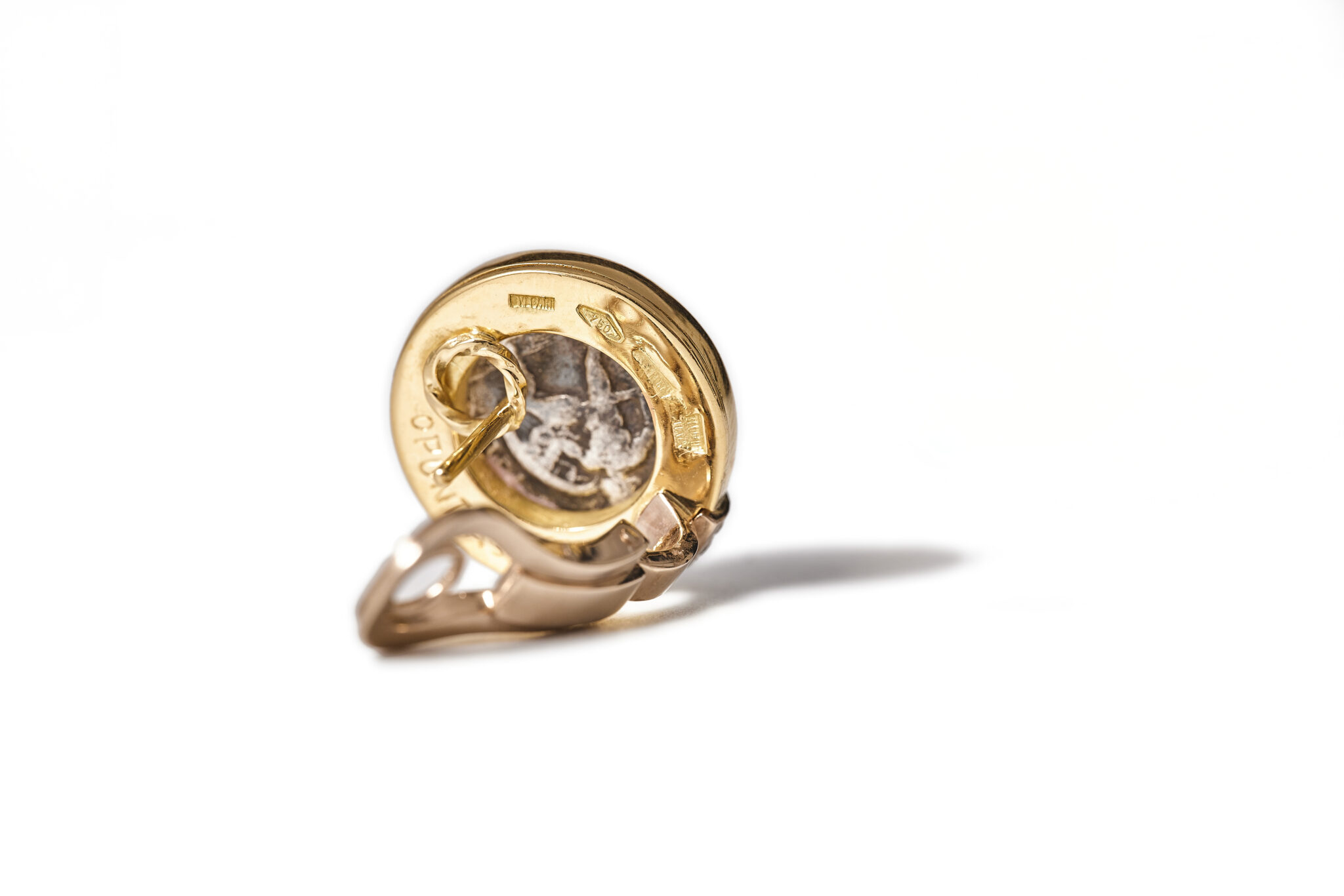
Two ancient coins from the 4th century BC. Light and Dark. One female and one male. The woman Opuntia – 360-350 ac, the man Olyntnos 432 – 348 ac. The earrings measure 17,8 x 18,7mm, each with six brilliant cut accents. Gross weight: 24,2gram. Hallmarked, 750, workshop, made in Italy and Signed Bvlgari.
Wear History!
Lokris Opuntia. Circa 356-336 BC.
AR Stater Wreathed head of Persephone right facing, Reverse Ajax advancing right, nude but for crested Corinthian helmet, holding sword in right hand and shield.
The fine and extensive coinage of the Opuntian Lokrians is surprising for a city whose place in history is relatively unknown. It has been suggested that the Lokrians, returning from service as mercenaries in Sicily, may have brought with them a quantity of Syracusan coins which would have provided bullion and the prototype for the ‘Euainetan’ head adopted at Lokris.
Persephone is one of the central figures of Greek mythology, known as the daughter of Demeter, goddess of agriculture, and queen of the Underworld. Her myth centers on her abduction by Hades, who takes her to the Underworld to be his wife. Demeter’s grief causes the earth to become barren, leading to famine. A compromise is reached: Persephone spends part of the year in the Underworld and part on earth. This cycle explains the changing seasons — her return brings spring and growth, her descent marks autumn and winter.
Persephone’s importance lies in her dual nature. She embodies both life and death, innocence and authority, acting as a bridge between worlds. In ancient religion, she was deeply connected to fertility, rebirth, and the mystery of life after death, particularly in the Eleusinian Mysteries.
Her story remains powerful as a symbol of transformation, cyclical renewal, and the balance between light and darkness.
Olyntnos 432 – 348 ac
Belivied to be ancient Greek coin, Macedon Chalkidian league. Silver Tetradrachm, Olynthos.
Aristonos, magistrate. Front: laureate head of Apollo right. Reverse: kithara with six strings, The coinage of the Chalkidian League is renowned for its high artistic quality and its expression of the political and cultural unity of this northern Greek confederation in the 4th century BC. Its tetradrachms typically depict the youthful head of Apollo, crowned with a laurel wreath, affirming his role as the League’s patron deity. The reverse features a kithara, symbolising Apollo’s association with music and poetry, accompanied by the inscription ΧΑΛΚΙΔΕΩΝ, naming the issuing authority.
Founded in the early 5th century BC and led by Olynthos, the Chalkidian League reached its height in the 4th century as a federation seeking regional cohesion and resistance to Macedonian expansion. Its uniform silver coinage facilitated trade and embodied collective identity, while the fine engraving and purity of the metal reflect the League’s prosperity and strategic importance in the northern Aegean.
Reference: Robinson & Clement-Group V, 134 (A82/P112); SNG ANS-497; SNG Lockett-1314; Boston MFA-581; HGC 3.1-500.
Apollo is one of the most important and complex gods of ancient Greece, associated with light, music, prophecy, healing, and the arts. The son of Zeus and Leto, and twin brother of Artemis, he was revered as a symbol of harmony, order, and intellectual clarity. Apollo’s sanctuary at Delphi became the most famous oracle in the Greek world, where his priestess delivered prophecies that shaped political and personal decisions across antiquity. He was also the patron of music and poetry, often depicted with a lyre, embodying ideal beauty and balance.
His importance lies in representing reason, culture, and refinement — a divine counterpart to chaos and excess. In both ancient and later Western thought, Apollo came to symbolize the ideals of proportion, intellect, and artistic perfection, making him one of the most enduring figures in classical mythology.
Bvlgari Monete – not only an interesting look, but they also show cultural heritage and are interesting conversation pieces due to the incredible history behind each piece. We just Adore the style!
It remains one of Bulgari’s most successful lines and is represented in the Bulgaris Heritage Collection and exhibited at their museum.
Vintage Monete are passionately sought after and have in recent years had a surge in demand.
Coins were not just forged as a means for trade transactions, but the images appearing on them could be symbols of power, sometimes symbolic talismans, and could manifest alliances between countries or families. Using antique coins in jewelry was not a new thing. The Roman nobility during Antiquity already did it, the style then had a revival during the 19th century, in particular with Roman jewelers like Castellani. The Bulgari family knew well this story, as some of the 19th century jewels were collected by Nicola Bulgari, as much as antique coins. He indeed wanted to be an archaeologist, so his fascination for the past was strong.
Bulgari’s Monete collection is flush with cultural currency. – “Reaching back through the centuries, Bulgari honors antiquity with Monete. Revering the artistic coins of yore. Bulgari contrasts them with the brilliance of its modern style.” Like a rare gem of inestimable historical value this ancient Roman coin has found a new life as precious jewel. The use of rare coins reflected Bulgari’s commitment to honoring history—any irregularities or signs of wear were preserved.
Monete pieces date back to the 1960s, when Rome was the epicenter of glamour the so called “La Dolce Vita” era. During this time Bulgari began to make Monete a feature of the house’s narrative. Evoking Bulgari’s artisanal craftsmanship, avant-garde materials and unrivalled design as a stylish way to reference the family’s Greek and Roman roots. As rare as precious stones, ancient coins, sourced from antiquarians and auction houses, are referred to as “gemme nummarie” (nummary gems) and straddle centuries of history.
Both Grace Kelly and Elisabeth Taylor are among the women who wore Bulgari’s Monete jewelry.