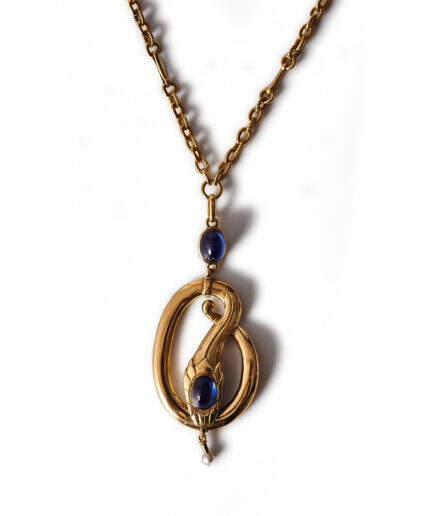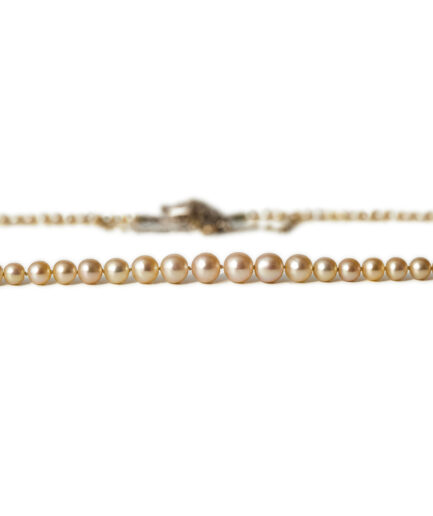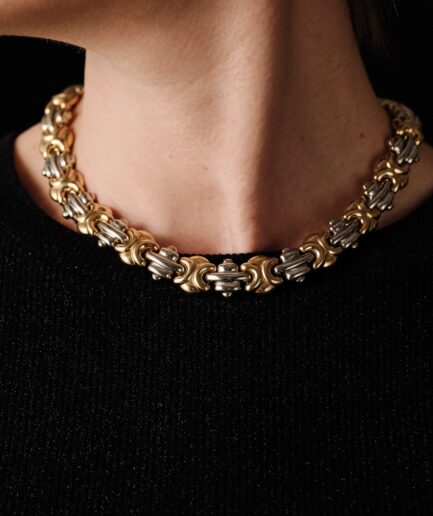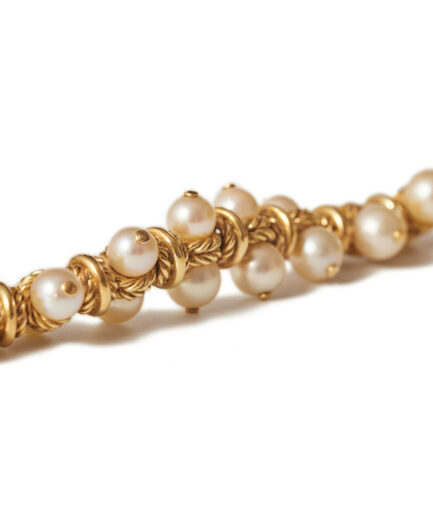


Andrew Grima ruby, emerald and diamond gold necklace.
We just adore this descreet and elegant necklace. Confident without overstating. Playful and still serious.
Width ca 3.5 – 5.0 mm, diameter of the clasp ca 15 mm, length approx 37.5 cm, total weight 27 grams. Signed Grima.
The rubies are estimated to have a total weight of 10.5cts, approx. 3.00 cts of emeralds and approx. 0.65 ct of diamonds.
“Since discovering the work of Andrew Grima, I have not only become a collector of his exquisite creations, I have also become one of the many to be inspired by his unique and inimitable designs. Each piece of jewellery, each watch, each object is a sculpture.” – Marc Jacobs
A colorful piece of history.
Andrew Grima’s jewelry of the 1960s, 1970s, and 1980s represents one of the most transformative chapters in modern jewelry history, shaped by an unconventional personal journey into the field. Born in Rome in 1921 to Italian and Maltese parents, raised in London, Grima did not begin his career as a jeweler. He trained as an engineer, a background that profoundly influenced his approach to design, construction, and problem-solving.
After serving in the Royal Air Force during World War II, Grima entered the jewelry world almost by chance in the late 1940s when he joined his father-in-law’s jewelry business in London. Largely self-taught, he approached jewelry without reverence for established conventions, instead applying an engineer’s mindset and an artist’s curiosity. This outsider perspective allowed him to rethink materials, surfaces, and structure, leading to a radical departure from traditional fine jewelry aesthetics.
By the 1960s, Grima had emerged as one of the most innovative designers of his generation. He rejected symmetry, high polish, and standardized gemstone cuts, favoring sculptural, heavily textured gold and gemstones left uncut or minimally altered. His work aligned closely with the cultural shifts of the era, embracing individuality, natural forms, and artistic freedom. Collectors included artists, intellectuals, and cultural tastemakers, and his reputation was cemented when he received royal commissions, including significant pieces for Queen Elizabeth II.
In the late 1960s, Grima relocated from London to Switzerland, seeking greater creative independence and access to exceptional craftsmanship. From his Swiss atelier, he continued to refine his distinctive language while maintaining its raw, organic spirit. During the 1970s and into the 1980s, his production evolved toward slightly more structured forms, yet retained the tactile surfaces, expressive silhouettes, and unconventional gemstone choices that define his work.
Today, Andrew Grima is regarded as a pioneer who reshaped the boundaries of fine jewelry. His pieces from the 1960s through the 1980s are highly collectible, valued not only for their bold aesthetic but for their lasting cultural significance. Grima’s legacy lies in proving that jewelry could function as wearable sculpture, rooted in craftsmanship yet liberated from tradition.